.png?width=100&height=100&name=white%20logo%20(1).png "white logo (1)")
.svg "Stonehouse Communications Logo (1)")
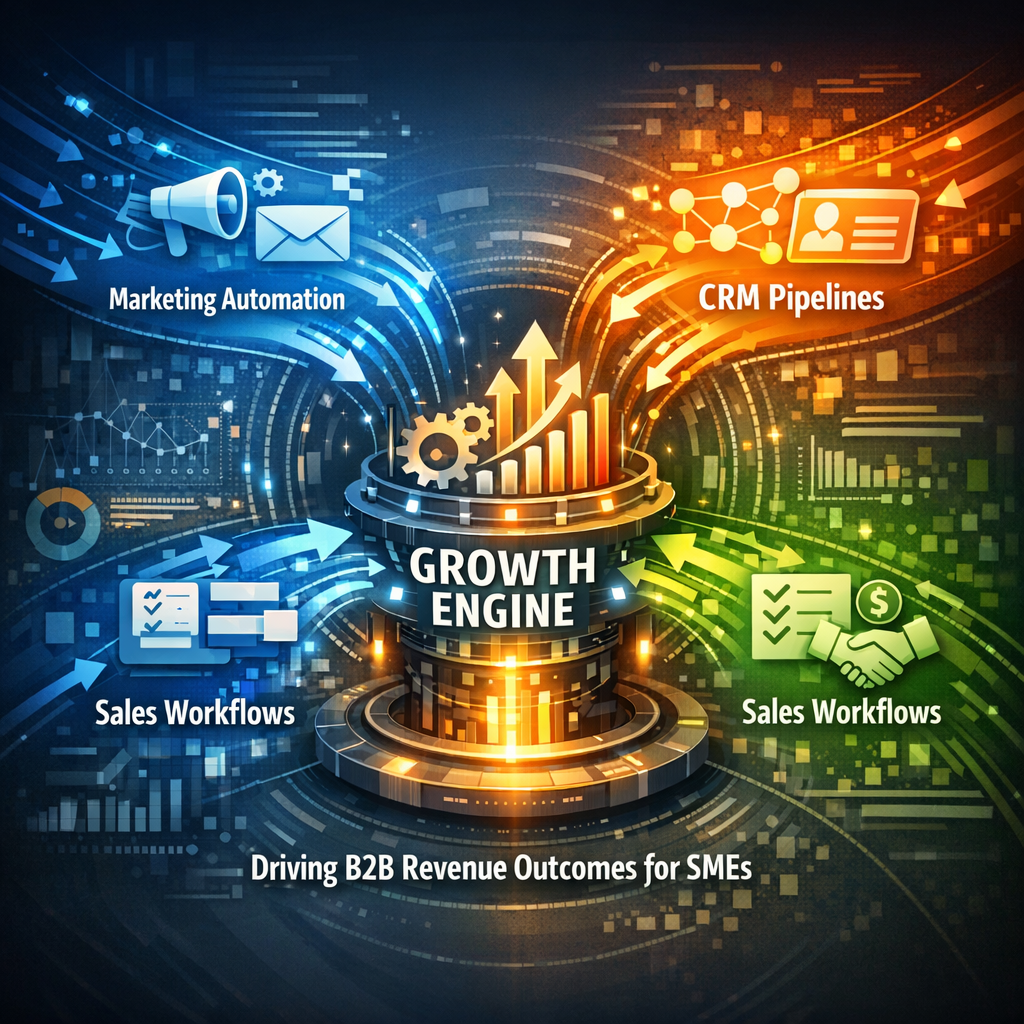
SMEs that achieve sustained B2B growth don't rely on disconnected campaigns—they architect integrated systems where marketing, sales, and operations function as a unified growth engine with measurable outcomes at every stage.
Why Disconnected Growth Efforts Fail SMEs in Competitive B2B Markets
B2B SMEs operating in competitive markets face a common structural challenge: marketing, sales, and operations function as separate entities with fragmented data, disconnected processes, and misaligned objectives. When marketing generates leads without visibility into sales pipeline progression, when sales teams lack context on prospect engagement history, and when operations cannot track revenue attribution back to specific campaigns, the result is predictable inefficiency. Resources are spent on activities that cannot be measured, opportunities fall through gaps between departments, and growth remains inconsistent.
This fragmentation manifests in recognisable symptoms. Marketing teams report campaign metrics in isolation—website traffic, content downloads, social media engagement—without connecting those activities to qualified opportunities or closed revenue. Sales teams spend valuable time qualifying leads that were never properly assessed by marketing, or worse, they fail to follow up on high-intent prospects because the handoff process lacks structure. Operations teams struggle to allocate budget effectively when they cannot determine which channels, campaigns, or content types actually drive pipeline growth.
The competitive disadvantage compounds over time. Whilst integrated competitors capture prospect data at first touch, nurture systematically through automated workflows, and convert efficiently with aligned sales processes, disconnected SMEs rely on manual effort at every stage. They lose prospects who require multiple touchpoints before converting, they miss buying signals because data lives in separate systems, and they cannot optimise because they lack visibility into what works. In markets where buyers research extensively before engaging with sales, this structural weakness directly impacts win rates and deal velocity.
The underlying issue is not lack of effort or individual capability—it is architectural. Without a unified system that connects marketing activity to sales outcomes, captures customer data consistently, and enables automated workflows based on prospect behaviour, even well-executed campaigns produce suboptimal results. SMEs that continue operating with disconnected tools, manual processes, and departmental silos find themselves competing at a structural disadvantage against organisations that have architected integrated growth engines.
Building the Foundation: Strategic Alignment Across Marketing, Sales, and Operations
At the heart of an integrated growth engine is strategic alignment: a shared definition of target customers, a common understanding of the buyer journey, and unified objectives that connect marketing activity directly to revenue outcomes. This alignment begins with clearly defining your ideal customer profile—not just demographic attributes, but the specific business challenges they face, the decision-making process they follow, and the information they require at each stage before committing to a purchase. When marketing, sales, and operations teams share this precise understanding, every subsequent decision—content topics, campaign timing, qualification criteria, sales messaging—derives from the same strategic foundation.
The buyer journey framework provides the structural logic for system design. Map the specific stages your prospects move through from initial awareness to closed customer: what triggers their recognition of a problem, what research they conduct before engaging with potential solutions, what evaluation criteria they apply when comparing options, what internal approvals they require before purchase. This mapping exercise reveals the touchpoints where marketing must provide content, the handoff points where sales should engage, and the data requirements that enable both teams to act on buying signals. Crucially, this framework must reflect how your buyers actually behave, not how you wish they would behave.
Revenue-oriented objectives replace activity-based metrics as the primary measure of success. Instead of tracking content downloads or email open rates in isolation, integrated systems measure how those activities contribute to pipeline generation, opportunity progression, and closed revenue. Marketing becomes accountable for qualified pipeline contribution, not just lead volume. Sales becomes responsible for converting marketing-qualified opportunities at defined rates, not just working whatever leads arrive. Operations tracks customer acquisition cost, lifetime value, and channel ROI to direct investment toward high-performing activities. These shared metrics create natural alignment because success requires collaboration.
Service level agreements (SLAs) formalise the commitments between teams. Marketing commits to delivering a specific volume of qualified leads based on agreed criteria—lead score thresholds, engagement indicators, firmographic fit. Sales commits to contacting those leads within defined timeframes and providing feedback on lead quality to enable continuous optimisation. Operations commits to maintaining system integrity, ensuring data quality, and delivering reporting that provides visibility into performance at every stage. These agreements transform abstract collaboration into specific operational requirements with measurable outcomes.
Implementing CRM Architecture That Mirrors Your B2B Buyer Journey
The CRM system functions as the operational foundation of your integrated growth engine, capturing every interaction across marketing, sales, and customer lifecycle stages within a single unified record. This architectural decision—using one system of record rather than separate tools for marketing automation, sales management, and customer service—eliminates the data fragmentation that creates blind spots and manual effort. When a prospect downloads content, attends a webinar, visits your website, receives an email, or speaks with a sales representative, each action writes to the same contact record with a complete activity timeline. This unified view enables both automated workflows and human decision-making based on comprehensive context rather than departmental fragments.
Pipeline architecture must reflect your specific buyer journey stages with precision. Define the exact progression from initial inquiry through qualified opportunity to closed customer, establishing clear entry criteria for each stage that can be evaluated programmatically. A marketing-qualified lead (MQL) might require three content engagements plus company size and industry match. A sales-qualified lead (SQL) might require conversation with a decision-maker who confirmed budget and timeline. An opportunity might require documented business case and identified stakeholders. These structured criteria enable automated stage progression, prevent premature advancement, and create reporting accuracy that shows exactly where prospects accumulate or drop off.
Custom properties capture the specific data points your business requires for qualification, prioritisation, and personalisation. Standard CRM fields—company name, contact details, job title—provide basic information, but strategic growth requires additional structure. For financial services firms, this might include current finance arrangements, refinancing timeline, and property portfolio size. For professional services, this might include service need categories, engagement urgency, and referral source. Because these properties are structured fields rather than free-text notes, you can trigger workflows, create segmentation rules, and build reporting that shows performance by segment without manual data extraction.
Integration architecture connects your CRM to the broader technology ecosystem. Marketing automation platforms synchronise campaign engagement data, website analytics platforms feed behavioural signals, communication tools log conversation history, and industry-specific applications write transaction outcomes back into the CRM record. Platforms such as form builders, scheduling tools, proposal software, and signature platforms should all integrate bidirectionally with your CRM so that data flows automatically rather than requiring manual updates. This integration architecture ensures that your unified record remains genuinely comprehensive without imposing additional administrative burden on your team.
Automation and AI-Driven Processes That Scale Without Adding Headcount
Workflow automation eliminates manual, repetitive tasks by defining rule-based processes that execute automatically when specific conditions are met. When a prospect submits a high-value content form, the system can automatically assign the lead to the appropriate sales representative based on territory or industry, send a personalised follow-up email sequence, create a task for outreach within 24 hours, and notify the account owner via email or Slack. When an opportunity reaches a specific stage, the system can trigger proposal generation, schedule internal reviews, and initiate customer onboarding processes. These workflows execute with perfect consistency, eliminating the manual effort and human error that occur when teams handle these processes individually.
Lead scoring provides algorithmic prioritisation based on engagement behaviour and firmographic fit. Assign point values to specific actions—website visits, content downloads, email opens, pricing page views, demo requests—with higher values for behaviours that correlate with purchase intent. Combine behavioural scoring with demographic and firmographic criteria: company size, industry match, job title relevance, geographic location. When a contact reaches your defined threshold, automated workflows can change their lifecycle stage, assign them to sales, or trigger immediate outreach. This systematic approach ensures that sales teams focus effort on prospects demonstrating genuine interest and strong fit rather than working through unsorted inquiry lists.
AI-driven capabilities within modern CRM platforms extend automation into predictive and generative territory. Predictive lead scoring uses machine learning to identify patterns in your historical data, determining which combination of characteristics and behaviours correlate most strongly with conversion. Breeze AI and similar tools can research target accounts automatically, identifying key stakeholders, recent company developments, and potential trigger events that signal buying intent. AI content generation can personalise email messaging at scale, adapting tone and emphasis based on prospect industry, role, and engagement history whilst maintaining your brand voice. These capabilities allow small teams to execute sophisticated, personalised engagement that would otherwise require substantial headcount.
The strategic value of automation extends beyond efficiency to consistency and data integrity. Manual processes introduce variation—different team members follow different steps, record information in different formats, and apply qualification criteria inconsistently. Automated workflows ensure that every prospect experiences the same systematic progression, every data point is captured in structured fields, and every stage transition meets defined criteria. This consistency produces clean data that enables accurate reporting, reliable forecasting, and continuous optimisation based on empirical performance rather than anecdotal observation.
Measuring Integration Success: Metrics That Connect Activity to Revenue Growth
Revenue attribution metrics connect marketing activities directly to pipeline generation and closed revenue, replacing vanity metrics with business outcomes. Track which specific campaigns, content assets, channels, and touchpoints contribute to opportunity creation by implementing multi-touch attribution models that assign credit across the entire buyer journey. First-touch attribution shows which campaigns generate initial awareness, last-touch attribution reveals what drives final conversion, and multi-touch models distribute credit proportionally across all interactions. This visibility enables strategic investment decisions: you can identify which content types generate highest-quality pipeline, which channels deliver best return on investment, and which campaigns should receive increased budget.
Pipeline velocity metrics measure how efficiently prospects move through your buyer journey stages, revealing bottlenecks that slow growth. Calculate the average time prospects spend in each stage from marketing-qualified lead through sales-qualified lead to opportunity and closed customer. Identify stages where progression slows or drop-off rates increase—these indicate process breakdowns, content gaps, or qualification mismatches that require attention. Track how these velocity metrics change over time as you optimise workflows, refine qualification criteria, and improve sales enablement. Reducing time-to-close by even a few days compounds significantly when applied across your entire pipeline.
Conversion rate optimisation focuses on systematic improvement at each stage transition point. Measure the percentage of marketing-qualified leads that convert to sales-qualified leads, sales-qualified leads that convert to opportunities, and opportunities that close as customers. Benchmark these conversion rates against your historical performance and industry standards, then run controlled experiments to improve them. Test different lead scoring thresholds, qualification criteria, nurture sequences, sales messaging, and follow-up timing. Because your integrated system captures complete data on every interaction, you can measure the impact of these changes precisely rather than relying on intuition.
Customer acquisition cost (CAC) and lifetime value (LTV) provide the financial framework for sustainable growth decisions. Calculate total sales and marketing expenditure divided by new customers acquired to determine your CAC. Track revenue generated by customer cohorts over time to calculate LTV. The LTV:CAC ratio indicates business model sustainability—ratios below 3:1 suggest acquisition costs are too high relative to customer value, whilst ratios above 5:1 may indicate underinvestment in growth. Monitor how these metrics trend as you scale: effective integrated systems should improve both metrics simultaneously by increasing conversion efficiency (lowering CAC) whilst better-qualified customers generate more revenue (increasing LTV).